Why precision matters in emerging market allocations
Resumen
Share
Marketing communication
Key takeaways
- Emerging markets (EM) have shown resilience in recent months, offering attractive valuations and a growth premium compared to developed peers.
- This growth potential has different drivers across regions, from tech-focused Asia to materials-rich Latin America (LatAm).
- EM economies today are a collection of idiosyncratic pockets of growth, which is why a more precise regional approach could capture specific opportunities across various sectors, thematics and styles.
Diverging growth drivers in emerging markets calling for precision in allocation
Emerging markets have proved resilient in the past 18 months,1 despite headwinds such as higher energy prices and evolving policy rate expectations.
There is regional dispersion across EM, with notable pockets of strength such as the AI-driven semiconductor demand driving growth in Asia, and Latin America’s cyclicality and high dividend yields.
These idiosyncrasies in EM prospects could warrant a more granular approach for investors2 looking to tap potential opportunities.
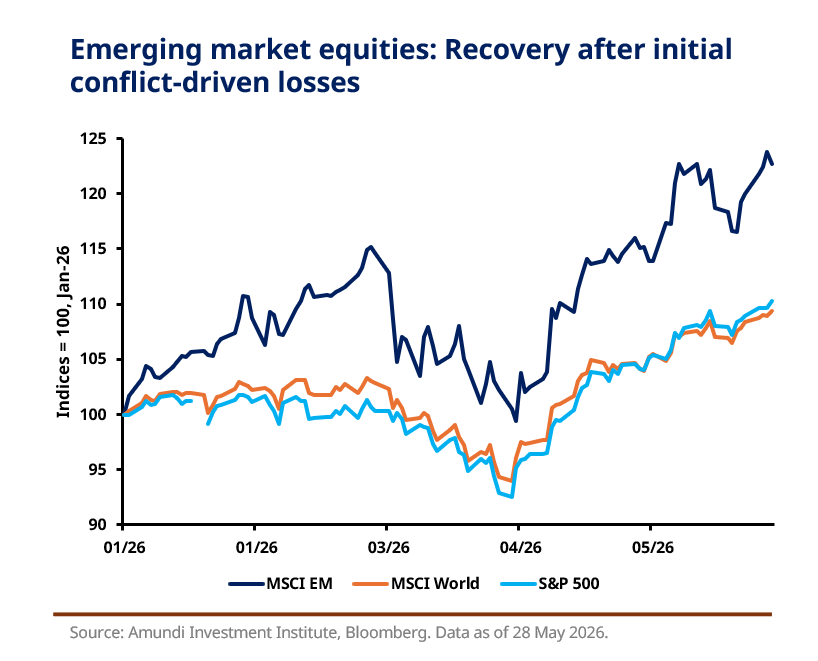
1. Global investment Views - Amundi Investment Institute - June 2026
The blockade of the Strait of Hormuz has had an outsize effect on some energy-hungry EM economies,3 though many have so far managed to put in place measures to mitigate the impact of the crisis.3
China4 and India5 comfortably beat economic growth expectations in the first quarter of the year, even as growth forecasts were revised downwards across developed markets (DM)..6
The MSCI Emerging Markets Index7 significantly outperformed8 MSCI World7 Index in the first quarter,9 as it did over the course of 2025.10
Asia: Artificial Intelligence (AI) as a growth driver but with nuances
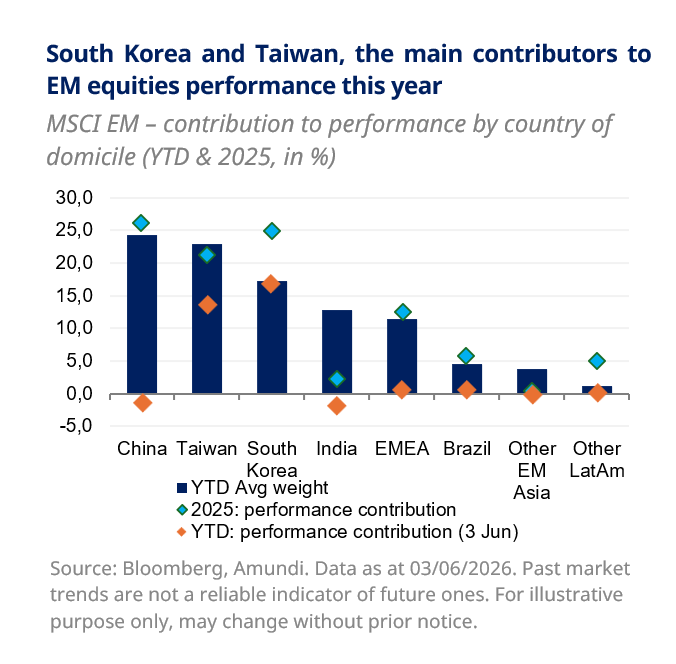
Many of the recent gains8 in EM have been led by tech-centric Asian economies that play a role in the AI supply chain, though India presents a different opportunity set altogether. Taken together, this is why investors may wish to consider a more selective approach.
Quarter to date (QTD), the MSCI South Korea index7 is up 80% while the MSCI Taiwan index7 is up 45% in USD terms,11 supported by robust demand for AI-related hardware.1
This data reflects the dominance of these countries in vital segments in the AI supply chain. South Korean chipmaking giants dominate the high-bandwidth memory manufacturing sector, supplying over 80%12 of these AI-enabling components worldwide. For advanced semiconductor manufacturing, Taiwan holds 92% total market share.13
In China, the introduction of US tariffs has led to a huge boom in the domestic technology industry, which spans the entire AI value chain, from critical mineral extraction to the production of copper-clad laminates for semiconductors, to a US$295 billion plan for a network of data centres.14 Chinese tech corporations already operate at scale and, under recent proposals, national champions will be favoured for the country’s AI buildout.
The MSCI China A Index7 could be an entry point to mainland China’s domestic tech ecosystem, with more than one-third of the index constituents in the IT sector.7
India is a different story. As a major energy importer, it has been hit hard by the ripple effect of the war in Iran. The rupee is down, foreign investment has fallen, and stock market valuations have dropped. Still, India remains an engine of global growth, due to its large consumer base, strong services sector, rising infrastructure investment, digitalisation, and government support for manufacturing. This was underlined in the first quarter GDP reading,1 which showed that the economy grew 7.8%.15
For potential access to Indian equities, MSCI India IMI Index7 includes large, mid and small caps in a wide-ranging index of 600+ stocks.
Latin America: Future-facing & attractive dividends
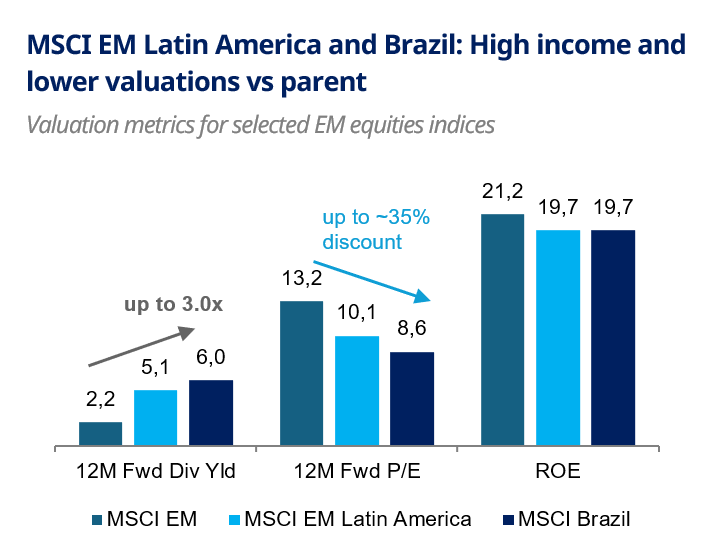
Valuations in Latin America are attractive compared to the rest of the EM bloc with positive earnings growth anticipated,15 particularly in Brazil, which is the largest constituent of the MSCI Emerging Markets Latin America Index at ~60%.7
Brazil makes up 3.8% of the MSCI Emerging Markets Index7 market capitalisation, highlighting how a more precise allocation could be warranted if investors wish to refine portfolio allocations. Although Brazilian stocks outperformed8 broad EM at the start of the year,15 a combination of monetary policy pressure and cyclical dynamics have pared gains.
The country has a crucial presidential election at the end of October. Incumbent Lula has taken an unorthodox approach to fiscal policy, which has left the country with a 9% annual deficit.
In contrast, Brazil’s central bank was ahead of the curve on tackling inflation, and real rates remain above 10%.16
Source: Amundi, Bloomberg. Data as at 31/05/2026. Past performance is not a reliable indicator of future performance. Investment involves risks. For more information, please refer to the Risk section at the end of the report. Past market trends are not a reliable indicator of future ones.
LatAm valuations, too, could be an important consideration, with discounts on both broad EM and World exposures.15
Financials (32%) and materials (22%) are the largest sectors in the MSCI Emerging Markets Latin America Index.7 These sectors could offer diversificatio17 in an EM allocation, while a dialled-up exposure to financials might provide higher dividend returns.8 In materials, LatAm is a major exporter of strategic metals, including copper and nickel, which are crucial for battery technology and AI development. By 2030, copper demand from AI infrastructure building is forecast to rise 10-fold.18
How to access the opportunity
EM economies today are a collection of idiosyncratic opportunities, each with their own dynamics, albeit with some overlap, in AI development, for instance. A broad EM allocation could help to capture the wide sweep of opportunities, given the bloc’s growth premium over DM.
However, precision matters for investors2 who may be seeking access to specific opportunities. This is why a more discerning regional selection of exposures could be considered. Allocating by country or region allows for a fine-tuning of investment portfolios2.
Amundi offers a large range of ETFs for investors who might wish to access EM exposures, whether broadly or with more precision.
1. Past market trends are not a reliable indicator of future ones.
2. Investment involves risks. For more information, please refer to the Risk section below.
3. Source: How the War in the Middle East Is Affecting Energy, Trade, and Finance – IMF, 30 March 2026.
4. Source: China's Q1 growth beats forecast as economy braces for fallout from Iran war – Reuters, 16 April 2026.
5. Source: India Remains Among the Fastest-Growing Economies Even As Growth Slows Amid Middle East Conflict; Outlook Vulnerable to Risks and Uncertainty – World Bank Group, 9 April 2026.
6. Source: Global Economy in the Shadow of War – International Monetary Fund, April 2026.
7. Source: MSCI, data as at 31 March 2026. For more information regarding the index methodology, please refer to www.msci.com. Past performance does not predict future returns.
8. Past performance does not predict future returns.
9. Source: Bloomberg, data as at 1 April 2026.
10. Source: MSCI, data as at 31 March 2026.
11. Source: Bloomberg. Quarter-to-date data covers 1 April to 10 June 2026.
12. Source: Korean equities: A diverging, concentrated market – London Stock Exchange Group, 5 June 2026.
13. Source: Global semiconductors: industry profile – ICAEW, 30 March 2026.
14. Source: China Preps US$295 Billion Plan to Fund Nationwide AI Buildout – Bloomberg, 9 June 2026.
15. Source: Government of India Ministry of Statistics and Programme Implementation – 5 June 2026.
16. Source: Brazil central bank flags demand-driven inflation as economists scale back rate-cut bets – Reuters, 3 June 2026.
17. Diversification does not guarantee a profit or protect against a loss.
18. Source: Copper in the Age of AI: Challenges of Electrification – S&P Gobal, 8 January 2026.
KNOWING YOUR RISK
It is important for potential investors to evaluate the risks described below, and in the fund’s Key Information Document (“KID”) for non-UK investors or Key Investor Information Document (“KIID”) for UK investors, and prospectus available on our websites www.amundietf.com.
CAPITAL AT RISK - ETFs are tracking instruments. Their risk profile is similar to a direct investment in the underlying index securities. Investors’ capital is fully at risk and investors may not get back the amount originally invested.
UNDERLYING RISK - The underlying index securities of an ETF may be complex and volatile. For example, ETFs exposed to Emerging Markets carry a greater risk of potential loss than investment in Developed Markets as they are exposed to a wide range of unpredictable Emerging Market risks
REPLICATION RISK - The fund’s objectives might not be reached due to unexpected events on the underlying markets which will impact the index calculation and the efficient fund replication.
COUNTERPARTY RISK - Investors are exposed to risks resulting from the use of an OTC swap (over-the-counter) or securities lending with the respective counterparty(-ies). Counterparty(-ies) are credit institution(s) whose name(s) can be found on the fund’s website amundietf.com. In line with the UCITS guidelines, the exposure to the counterparty cannot exceed 10% of the total assets of the fund.
CURRENCY RISK – An ETF may be exposed to currency risk if the ETF is denominated in a currency different to that of the underlying index securities it is tracking. This means that exchange rate fluctuations could have a negative or positive effect on returns.
LIQUIDITY RISK – There is a risk associated with the markets to which the ETF is exposed. The price and the value of investments are linked to the liquidity risk of the underlying index securities. Investments can go up or down. In addition, on the secondary market liquidity is provided by registered market makers on the respective stock exchange where the ETF is listed. On exchange, liquidity may be limited as a result of a suspension in the underlying market represented by the underlying index tracked by the ETF; a failure in the systems of one of the relevant stock exchanges, or other market-maker systems; or an abnormal trading situation or event.
VOLATILITY RISK – The ETF is exposed to changes in the volatility patterns of the underlying index relevant markets. The ETF value can change rapidly and unpredictably, and potentially move in a large magnitude, up or down.
CONCENTRATION RISK – ETFs can select a large portion of their assets in a particular issuer, industry, stocks or type of bonds, country or region for their portfolio. Where selection rules are extensive, it can lead to a more concentrated portfolio where risk is spread over fewer stocks. Where selection rules are extensive, it can lead to a more concentrated portfolio where risk is spread over fewer stocks. This can mean both higher volatility and a greater risk of loss.
IMPORTANT INFORMATION
This material is solely for the attention of professional and eligible counterparties, as defined in Directive MIF 2014/65/UE of the European Parliament acting solely and exclusively on their own account. It is not directed at retail clients. In Switzerland, it is solely for the attention of qualified investors within the meaning of Article 10 paragraph 3 a), b), c) and d) of the Federal Act on Collective Investment Scheme of June 23, 2006.
This information is not for distribution and does not constitute an offer to sell or the solicitation of any offer to buy any securities or services in the United States or in any of its territories or possessions subject to its jurisdiction to or for the benefit of any U.S. Person (as defined in the prospectus of the Funds or in the legal mentions section on www.amundi.com and www.amundietf.com. The Funds have not been registered in the United States under the Investment Company Act of 1940 and units/shares of the Funds are not registered in the United States under the Securities Act of 1933.
This material reflects the views and opinions of the individual authors at this date and in no way the official position or advices of any kind of these authors or of Amundi Asset Management nor any of its subsidiaries and thus does not engage the responsibility of Amundi Asset Management nor any of its subsidiaries nor of any of its officers or employees. This research is not an offer to sell or the solicitation of an offer to buy any security in any jurisdiction where such an offer or solicitation would be illegal. It is explicitly stated that this document has not been prepared by reference to the regulatory requirements that seek to promote independent financial analysis. It does not constitute a personal recommendation or take into account the particular investment objectives, financial situations, or needs of individual clients. Neither Amundi Asset Management nor any of its subsidiaries accept liability, whether direct or indirect, that may result from using any information contained in this document or from any decision taken the basis of the information contained in this document. Clients should consider whether any advice or recommendation in this research is suitable for their particular circumstances and, if appropriate, seek professional advice, including tax advice. Our salespeople, traders, and other professionals may provide oral or written market commentary or trading strategies to our clients and principal trading desks that reflect opinions that are contrary to the opinions expressed in this research. Our asset management area, principal trading desks and investing businesses may make investment decisions that are inconsistent with the recommendations or views expressed in this research.
This document is of a commercial nature. The funds described in this document (the “Funds”) may not be available to all investors and may not be registered for public distribution with the relevant authorities in all countries. It is each investor’s responsibility to ascertain that they are authorised to subscribe, or invest into this product. Prior to investing in the product, investors should seek independent financial, tax, accounting and legal advice.
This is a promotional and non-contractual information which should not be regarded as an investment advice or an investment recommendation, a solicitation of an investment, an offer or a purchase, from Amundi Asset Management (“Amundi”) nor any of its subsidiaries.
The Funds are Amundi UCITS ETFs and Amundi ETF designates the ETF business of Amundi.
Amundi UCITS ETFs are passively-managed index-tracking funds. The Funds are French, Luxembourg or Irish open-ended mutual investment funds respectively approved by the French Autorité des Marchés Financiers, the Luxembourg Commission de Surveillance du Secteur Financier or the Central Bank of Ireland, and authorised for marketing of their units or shares in various European countries (the Marketing Countries) pursuant to the article 93 of the 2009/65/EC Directive.
Before any subscriptions, the potential investor must read the offering documents (KID for non-UK investors or KIID for UK investors, and prospectus) of the Funds.
Investment in a fund carries a substantial degree of risk (i.e. risks are detailed in the KID for non-UK investors or KIID for UK investors, and prospectus). Past Performance does not predict future returns. Investment return and the principal value of an investment in funds or other investment product may go up or down and may result in the loss of the amount originally invested. All investors should seek professional advice prior to any investment decision, in order to determine the risks associated with the investment and its suitability.
It is the investor’s responsibility to make sure his/her investment is in compliance with the applicable laws she/he depends on, and to check if this investment is matching his/her investment objective with his/her patrimonial situation (including tax aspects).
Please note that the management companies of the Funds may de-notify arrangements made for marketing as regards units/shares of the Fund in a Member State of the EU or the UK in respect of which it has made a notification.
A summary of information about investors’ rights and collective redress mechanisms can be found in English on the regulatory page at https://about.amundi.com/legal-documentation with respect to Amundi ETFs.
This document was not reviewed, stamped or approved by any financial authority.
This document is not intended for and no reliance can be placed on this document by persons falling outside of these categories in the below mentioned jurisdictions. In jurisdictions other than those specified below, this document is for the sole use of the professional clients and intermediaries to whom it is addressed. It is not to be distributed to the public or to other third parties and the use of the information provided by anyone other than the addressee is not authorised.
This material is based on sources that Amundi and/or any of her subsidiaries consider to be reliable at the time of publication. Data, opinions and analysis may be changed without notice. Amundi and/or any of her subsidiaries accept no liability whatsoever, whether direct or indirect, that may arise from the use of information contained in this material. Amundi and/or any of her subsidiaries can in no way be held responsible for any decision or investment made on the basis of information contained in this material.
Units of a specific UCITS ETF managed by an asset manager and purchased on the secondary market cannot usually be sold directly back to the asset manager itself. Investors must buy and sell units on a secondary market with the assistance of an intermediary (e.g. a stockbroker) and may incur fees for doing so. In addition, investors may pay more than the current net asset value when buying units and may receive less than the current net asset value when selling them.
Indices and the related trademarks used in this document are the intellectual property of index sponsors and/or its licensors. The indices are used under license from index sponsors. The Funds based on the indices are in no way sponsored, endorsed, sold or promoted by index sponsors and/or its licensors and neither index sponsors nor its licensors shall have any liability with respect thereto. The indices referred to herein (the “Index” or the “Indices”) are neither sponsored, approved or sold by Amundi nor any of its subsidiaries. Neither Amundi nor any of its subsidiaries shall assume any responsibility in this respect.
In EEA Member States, the content of this document is approved by Amundi for use with Professional Clients (as defined in EU Directive 2004/39/EC) only and shall not be distributed to the public.
Information reputed exact as of 15 June 2026.
Reproduction prohibited without the written consent of Amundi.
---------------------------------------------------------------------------------------
Amundi Asset Management (Amundi AM)
French “Société par Actions Simplifiée” - SAS with a share capital of €1 143 615 555
Portfolio management company approved by the French Financial Markets Authority (Autorité des Marchés Financiers) under no.GP 04000036
Head office: 91-93, boulevard Pasteur, 75015 Paris - France
Postal address: 91, boulevard Pasteur, CS 21564, 75730 Paris Cedex 15 - France
Tel : +33 (0)1 76 33 30 30
Siren no. 437 574 452 RCS Paris